
May 11, 2022
By: Early Edge California, Advancement Project California, and Glen Price Group (GPG), in partnership with First 5 California and the California Department of Education
This blog is the eleventh post in a series of blog posts about the First 5 California (F5CA) Dual Language Learner (DLL) Pilot Community of Practice (CoP). Click here for additional blog posts.
Resources for Educators and the Field
California Department of Education (CDE)
AIR Newly Released Research Briefs
Multilingual Learning Toolkit
Center on the Developing Child at Harvard
Resources shared by Center for Equity for English Learners (CEEL)
Policy Implications
The April meeting of the F5CA DLL Pilot Community of Practice (CoP) continued to focus on the topic initially started in March: strengthening articulation and alignment between the Early Childhood Education (ECE) and TK-12 systems. Specifically, April covered the subtopics of:
State Efforts to Support Data Sharing and DLL Identification
California Department of Education representatives Lillie Moffet; Society for Research in Child Development (SRCD) State Policy Fellow, and Patrisia Gonzalez; Child Development Consultant, Early Education Division, shared the CDE’s current efforts to support DLLs at the intersection of the ECE and TK-12 systems.
Representatives shared the CDE’s aspirations for data to be more easily transferred between agencies and for data to be more easily accessible to all those involved in supporting children as a means to be able to effectively inform their work with the child. The CDE is working to make it easier for the current data systems [Child Development Management Information System (CDMIS) and California Longitudinal Pupil Achievement Data System (CALPADS)] to communicate with each other. In the meantime, the CDE encourages local school districts and organizations to build data sharing agreements into their UPK planning processes.
Representatives also provided insight on data collection efforts related to AB 1363. AB 1363 requires California State Preschool Programs (CSPP) to identify and report data on the number of DLLs in their programs. The goal of these data collection efforts is to improve program quality and support informed decision making at the state and local levels.
Representatives shared the process CSPP educators and administrators will use to identify and report the number of DLLs in their programs. The recently developed Family Language Instrument will be completed by families upon enrollment, and based on their responses, may trigger a Family Language Interview conducted by the CSPP teachers or program staff. It will provide useful information for educators, including strengths and interests of the child and the child’s experiences with language learning. This interview protocol will also support early relationship building efforts between CSPP educators and the families they serve. The CDE will be creating a data portal called the Preschool Language Information System (PLIS) for CSPP programs to report their data related to the number of DLLs in their programs. Details on reporting timelines and other information will be released in upcoming Management Bulletins.
Presentation by the Center for Equity for English Learners (CEEL)
Magaly Lavadenz, Ph.D; Distinguished Professor and Executive Director of CEEL, and Elvira Armas, Ed.D; Affiliate Faculty and Director of Programs and Partnerships at CEEL, shared a presentation on equity focused DLL assessment, articulation, and alignment.
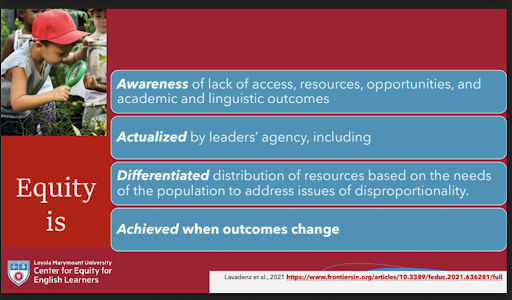
The presentation began with CEEL’s definition of equity as illustrated in the slide below.
Slide from CEEL presentation.
California has the largest number of Dual Language Learners aged 0-5 in the United States. As such, California stands at a historical crossroads in developing programs, processes, and strategies to support DLLs and their families. To support these efforts, CEEL has compiled an annotated bibliography of relevant research, policies, and practices.
CEEL representatives also shared local bright spots. The Fresno Language Learning Project includes a Family Language and Interest Interview tool (see pgs 114-117) as a way to support participating programs in identifying DLLs. Additionally, First 5 San Diego and San Diego County Office of Education worked together to develop the report, A Successful Approach to Connecting Early Childhood and Elementary School Data which describes their local efforts to better align data between the ECE and TK-12 systems.
Orange County and San Francisco County Presentations
Orange county and San Francisco county presented their local efforts to strengthen articulation and alignment between the ECE and TK-12 systems.
Jennifer Martinez; QRIS Coordinator from First 5 San Francisco, and Jennifer Delos Reyes; Executive Director for Performance, Quality, and Enhancements at San Francisco Unified School District Early Education Department, highlighted the long standing connections between their agencies in collaboratively supporting multilingual learning and bilingualism through the Soy Bilingüe model and other efforts. Additional partnership work includes ongoing support for DLLs within LEAs as well as collaborative presentations on school readiness and UPK expansion in multiple languages.
Catalina Sanchez; Coordinator at Orange County Department of Education, discussed their local efforts to align the ECE and TK-12 systems to better support DLLs. The Orange County Department of Education (OCDE) is the official National Training Center (NTC) for the Project GLAD (Guided Language Acquisition Design) model. Orange county supports children as they transition between the Preschool Glad model and the Project Glad model used in TK-12 schools.
Community of Practice Member Discussion Highlights
CoP members discussed recommendations for the CDE, the CDSS, the CTC, First 5 CA, the Governor’s Office, and other related California agencies to better strengthen the alignment between the ECE and TK-12 systems and to better share data across involved partners. Recommendations included:
“The DLL supports that children receive in early learning programs builds a strong foundation for lifelong literacy and language development. It’s imperative that our TK-12 systems build upon this foundation to accelerate progress. This necessitates an intentional focus on bridging systems and supporting transitions.”
—DLL Pilot CoP Member
This blog will be updated regularly to share the emerging lessons learned, needed resources, and policy recommendations coming from the DLL Pilot CoP meetings. Learn more about the First 5 CA DLL Pilot.