Early Edge Blog
Early Edge Policy Corner: Early Edge Visits Bay Area Family Child Care Homes
February 19, 2026
By: Andrew Avila, Policy Analyst, Early Edge California
When the 2025 legislative session concluded in September, marking a year of advocacy in Sacramento for policy changes to stabilize California’s mixed‑delivery early learning and care (ELC) system, it was time to visit the providers, often called “the workforce behind the workforce,” and learn what they need to continue serving families and their young children.
In November 2025, I had the opportunity to visit three Family Child Care Home (FCCH) providers in the Bay Area, a region where child care is often difficult to access and often unaffordable. I, along with our Policy Director, Carolyne Crolotte, was graciously hosted by FCCH providers Joi West, Benu Chhabra, and Khulood Jamil to learn about their programs and their experiences.
Why are site-visits important for policy? Site visits allow advocates like Early Edge and, more importantly, our elected representatives, to see firsthand how programs operate, understand the real-world circumstances and challenges providers face, and witness the impact of policies on the providers, families, and young children they are meant to serve. Seeing these realities up close is crucial in informing the creation of effective policies that truly support the people they are intended to help.
Continue reading to learn a bit about each provider, their program, a few of the many challenges they face in their essential work, and key takeaways that I took from the visits.
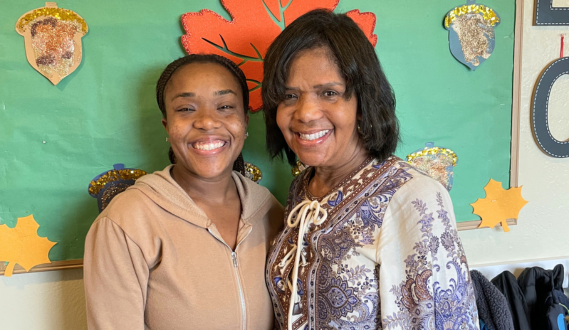
FCCH provider Joi West with daughter D'Auria West
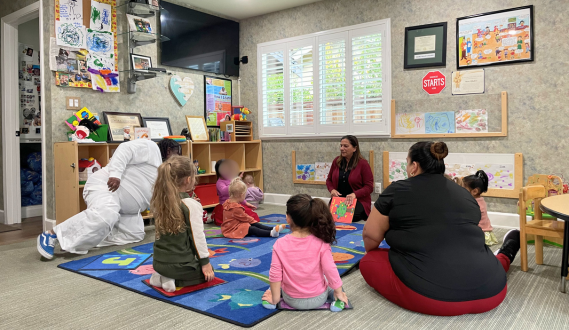
FCCH provider Benu Chhabra reading a book
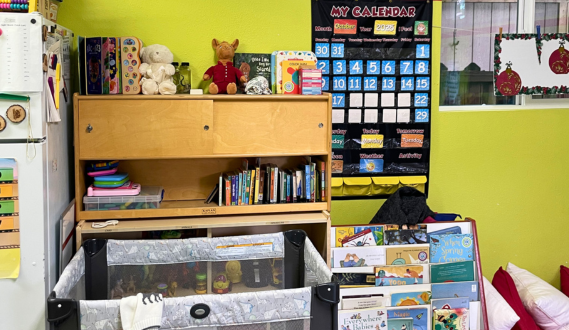
Child care setting from FCCH provider Khulood Jamil
Joi West, City of Oakland
Joi West operates a family child care home in the City of Oakland alongside her daughter, who is on staff and also hopes to open her own program one day. Together, they form a mother-daughter provider team serving young children, including two infants. Many families found Joi’s program through word of mouth, reflecting years of trust built with parents and relationships within the community. As children wrapped up snack time at the communal table and returned to the play area, Joi pointed out her refrigerator and stovetop, explaining that both were purchases made possible from the Infrastructure Grant Program. She shared how these necessities, along with a washer and dryer obtained through the same grant, have been essential in her ability to provide quality care, nutrition, and clean clothes and bedding for the little ones.
Joi’s Challenges
A two-time cancer survivor, Joi shared that she was forced to close her FCCH for ten months at one point due to health challenges, and that healthcare would be unattainable and unaffordable if she were not covered through her husband’s employer. She also described struggling with the 80/20 rule, which requires providers to spend at least 80% of their operational time on child care and limits other activities, making it especially hard during illness or family funerals. Joi worries about her retirement as a child care provider, a benefit the state has only recently begun offering to FCCHs. “I know providers who are 70, 80, still doing child care,” said Joi. “They should have been able to retire already, but they can’t.” Along with supports that facilitate pathways to retirement Joi believes there should be more support for staff to take child development classes, along with stronger pathways for early educators to open and sustain their own businesses.
Benu Chhabra, City of Concord
For Benu Chhabra in the City of Concord, caring for young children has been a lifelong calling, which she discovered at fourteen when she first began caring for children. During morning story time, infants and toddlers were gathered in a circle as Benu read aloud, using sign language and expressive gestures to support language development and inclusion for all learners. As a California Mentor Teacher at Diablo Valley College, Benu emphasized the importance of students gaining hands-on experience with young children so early educators can build practical skills, confidence, and a broader understanding of child development that cannot be learned in a classroom alone.
Benu’s Challenges
Benu shared that staffing remains one of her greatest challenges. She described how running a FCCH truly takes a village, with her husband stepping in to help as support when needed. Recruiting and retaining staff has become increasingly difficult as she must compete with other industries that offer higher wages and more predictable benefits. “It’s hard for child care to compete with fast food jobs that pay more,” said Benu. “You can’t compete.”
Khulood Jamil, City of Pleasant Hill
Having first started her child care career in an apartment, Khulood Jamil now owns a large FCCH in the City of Pleasant Hill. In her backyard, toddlers participate in a multilingual and illustrated learning activity in English, Spanish, and Arabic. Passionate about her care, Khulood shared how, for one toddler, she is the only trusted person able to deliver asthma medication, something the toddler’s parents struggle to do calmly. “Those children are mine,” said Khulood. “I’m their second mom. I see their milestones.”
Khulood’s Challenges
Khulood shared that her participation in the California Child Care Food Program (CACFP) does not provide nearly enough reimbursement to cover the cost of food, and that reimbursement would need to be at least three times higher to effectively support providers in delivering nutritious snacks and meals to young children. She spoke about her commitment to helping other providers pursue further education and her desire to mentor those looking to open their own Family Child Care Homes.
Takeaways
For me, these visits highlighted the dedication, resilience, and skill of FCCH providers, who, while navigating challenges such as low CACFP reimbursements, healthcare and retirement insecurity, staffing shortages, and restrictive rules like the 80/20 requirement, draw on supports like infrastructure grants, multilingual learning tools, mentorship, and hands-on training to provide nurturing, high-quality care for infants and toddlers, guiding the next generation of early educators, and fighting for rate reform to reflect the true cost of providing quality child care. As part of the policy team at Early Edge, the highlighted challenges from providers are issues we are looking to address, along with our continued advocacy for rate reform to reimburse providers for the true cost of care.
Learn more about California’s Early Learning and Care Workforce, including FCCH providers, by visiting our Workforce Compensation, Supports & Pathways priority page.