
September 9, 2021
By: Early Edge California, Advancement Project California, and Glen Price Group (GPG), in partnership with First 5 California and the California Department of Education
This blog is the third post in a new series about the DLL Pilot CoP. See here for additional blog posts.
Resources for Educators and the Field
Policy Implications
California seeks to make systemic progress towards centering the cultural and linguistic assets of DLL children and families as a means to fully support them to reach their full potential. To do this necessitated a focus on improving systems of support for DLLs. The June meeting of the F5CA DLL Pilot Community of Practice (CoP) specifically focused on the topic of ensuring Quality Counts California (QCC) is culturally and linguistically responsive. Carolyne Crolotte, Director of DLL Programs with Early Edge California, and Vickie Ramos Harris, Director of Educational Equity for Advancement Project California, presented on national and state research on this topic. To frame the discussion, CoP members read Rating Program Quality for Dual Language Learners in Early Ed.
Much of the discussion through the CoP focused on ways counties have included DLL-related indicators into their local QCC matrices. For example, Fresno includes DLL indicators in their local QCC matrix; San Mateo revised the rating matrix element 4 to expand beyond CLASS and looked at culturally and linguistically responsive practices in classrooms; Monterey launched a program called Language is a Gift for in-home educators that has been integrated into QCC; and Sonoma has translated QCC materials into Spanish and offers TALLK or Teachers Acquiring Language Learner Knowledge for the county’s workforce. While there are a number of bright spots in the state, counties were clear that integrating DLL indicators into their local QCC matrices is challenging because there is a need for a systemic approach at the state level that includes supports and incentives as well as capacity building. Counties are challenged in maintaining local progress in these areas without clear guidance and emphasis from the state. In addition, funding is insufficient to adequately support educators and programs to advance these indicators. Counties noted that there is a substantial need for translated materials (reference documents, trainings, classroom materials, etc.) and that without these resources, counties face challenges sharing best practices for working with DLL students and families.
“If there isn’t an agreed upon or standardized tool, leadership is chasing their tails trying to reconcile philosophical beliefs with where to start working. [There is a need for] having solid, rich resources that leadership, coaches, and providers can use to guide implementation of best practices [for DLLs] at the classroom level and beyond.”—CoP Member
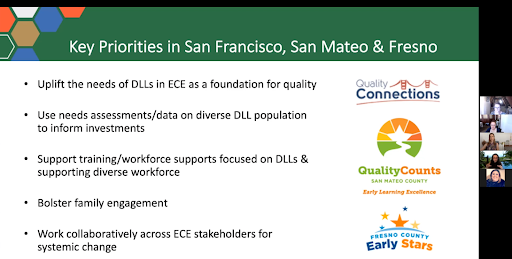
CoP members heard a presentation from Carolyne Crolotte (Early Edge California) and Vickie Ramos Harris (Advancement Project California) on the topic of ensuring Quality Counts California (QCC) is culturally and linguistically responsive and highlighted local bright spots.
This blog will be updated regularly to share the emerging lessons learned, needed resources, and policy recommendations coming from the DLL Pilot CoP meetings. Learn more about the First 5 CA DLL Pilot.